
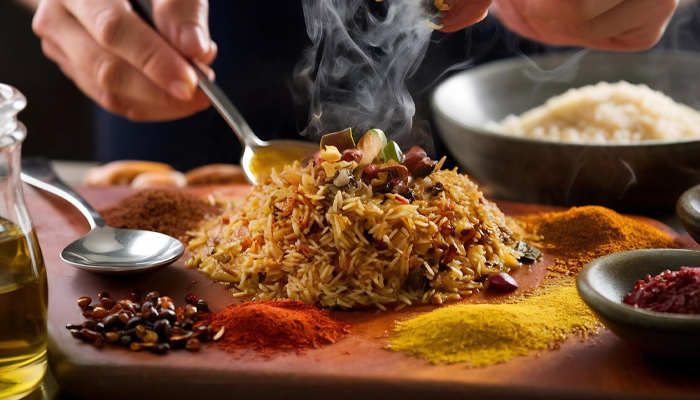
When biryani arrives at your table, it feels finished. Complete. Effortless.
Steam rises slowly, carrying an aroma that fills the space before you even lift your fork. The rice looks light but structured. Nothing clumps. Nothing looks forced. It feels like it came together naturally. But biryani never comes together naturally. It comes together deliberately.
Onions Become Something Else Entirely
When onions meet heat, they do not transform instantly. At first, they release moisture. The sharp smell fades slowly. Their texture softens. Their color deepens. Given enough time, onions stop behaving like onions.
They become something quieter. Sweeter. Warmer. They stop standing apart and begin forming the base of the dish. This stage cannot be rushed.
If stopped too early, the biryani will feel incomplete. Something will feel missing, even if guests cannot identify it. The onions create depth that nothing else can replace.
Spice Is Not Added for Intensity, It Is Added for Structure
Spices enter gradually. Cumin seeds hit hot oil and release their aroma immediately. Cardamom softens the atmosphere around it. Cloves add quiet sharpness that settles over time. Each spice enters at the moment it needs to. Too early, and it burns. Too late, and it never fully integrates.
Spices do not exist to dominate the dish. They exist to support it. To create structure beneath the surface.
Rice Is Prepared Carefully, Not Fully
Rice is never fully cooked at the beginning. It becomes part of the biryani instead of sitting beside it. Layering Defines the Dish More Than Cooking Does This is where biryani becomes biryani. Rice and spiced components are layered. Not mixed. Each layer exists clearly at first.
This separation is intentional. It allows flavor to travel slowly. It prevents any single element from overwhelming the others too soon. Layering protects balance. It ensures the final dish feels unified, not chaotic.
Steam Finishes What Fire Began
Once layering is complete, the pot is covered. The flame remains low. Nothing dramatic happens from the outside. Steam rises gently. It carries aroma upward and downward at the same time. It moves through every grain. Every space between layers. Nothing is forced. Nothing is rushed.
Waiting Is the Most Important Part
This stage feels uneventful to anyone watching. The pot remains closed. The kitchen remains quiet. Nothing moves visibly. But this waiting defines everything. Opening the pot too early interrupts integration. Completion cannot be forced. It has to be allowed.
The First Opening Reveals the Result of Patience
When the pot is finally opened, the aroma escapes immediately.
Not aggressively. This is the first visible moment of something that began long before. Everything that needed to happen has already happened.
Nothing needs correction.
Guests Experience Only the Final Moment
When biryani reaches your table in Cary, guests experience the final result. They smell it. They taste it. They feel its warmth. They do not see the waiting. The layering. The preparation that made it possible. Even without knowing the process, they feel its presence.